Case Study

Reclaiming Assessment Validity in the Age of Online Learning

A Case Study on Score Distributions and Remote Proctoring

By Trevor Basil, PhD, in Collaboration with Kevin Rockmael

Executive Summary

In early 2026, Dr. Trevor Basil noticed something unusual in his online classes at two California colleges. Unproctored quizzes were producing almost all near-perfect scores. The results were tightly clustered at the top, a clear ceiling effect, making it difficult to tell who truly understood the material and who did not.

When remote proctoring was introduced, that pattern changed. Scores spread out across the grading scale and began to look more like those from a typical in-person, supervised classroom. The change continued in later quizzes, and online proctored classes closely matched in-person results.

Grades did not suddenly drop. Strong students still performed well. What changed was that the exams could once again distinguish different levels of performance. The study suggests that remote proctoring can help restore the basic purpose of an assessment: accurately measuring what students know.


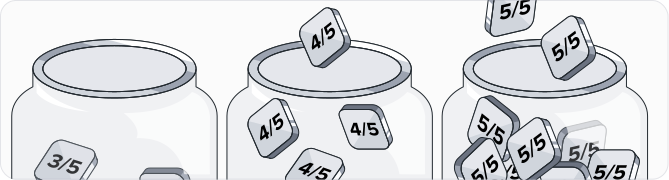
Executive Summary illustration
Restoring Normalcy illustration

Restoring Normalcy:A Classroom Study on Remote Proctoring and Score Distributions

In early 2026, Dr. Trevor Basil, a psychology professor teaching at two California institutions, noticed something unusual. Scores from students taking his online quizzes were nearly perfect. Most students were receiving grades at or near the maximum. There was very little variation.

When that happens, the assessment may no longer measure differences in understanding. It may fail to distinguish preparation from guesswork. At that moment, it stops functioning as a reliable instrument.

Rather than speculate, he ran a structured comparison.

The question was
straightforward

What happens to score distributions when remote proctoring is introduced?

Study Design

These are different institutions, different students, different courses.

All other variables remained the same: instructor, content, grading standards, assignments.

The study took place at two different colleges:

DeAnza College

Research Methods

Cal State Fullerton

Research Methods

Three quizzes were administered in sequence:

Quiz 1

No proctoring

Quiz 2

Proctoring introduced

Quiz 3

Proctoring continued

In addition, one course was taught in parallel formats:

One Section In Person

Physically Monitored

One Section Online

Remotely proctored

What Happened Without Proctoring
Quiz 1: No Proctorio

Quiz 1 (Chart 1 below) produced a compressed distribution. Scores at both institutions clustered tightly at the maximum value. Density plots showed minimal spread. Most students earned near-perfect results.

That pattern appeared at both institutions. When a large group of students all score at the top, it becomes difficult to determine actual differences in mastery. The test loses resolution and validity. The key point: the distribution was not normal. It showed a strong ceiling effect, with most students achieving the maximum or near-maximum score.

What Changed with Proctoring?
Quiz 2 • Proctorio Added

When proctoring was introduced using Proctorio in Quiz 2 (Chart 2), the distribution changed immediately. Scores spread across the full grading scale, and variance returned. The density curve resembled a normal distribution rather than a spike at the maximum. In other words, the ceiling effect disappeared.

Statistically, paired t-tests comparing Quiz 1 and Quiz 2 showed p-values less than .001 at both institutions. That means the change was highly unlikely to be random, and that the two score distributions were significantly different from each other, removing the ceiling effect. Grades did not collapse. They showed normal and expected distributions.

Did the Effect Persist?
Quiz 3 • Proctorio Continued

To determine whether this was temporary, Quiz 2 was compared to Quiz 3 (both proctored).

As you can see from below (Chart 3), there was no statistically significant difference. A p-value greater than .05 indicates that there is no statistically significant difference between the two distributions. In other words, the ceiling effect observed earlier was successfully removed, resulting in normally distributed scores where the online asynchronous quiz performed similarly to the in-person, proctored quiz.

The largest shift occurred when proctoring was introduced. After that, performance patterns remained consistent.

This pattern suggests that expectations changed quickly. When monitoring was introduced, the assessment environment shifted. Students adjusted. The system recalibrated.

Dr. Basil described it clearly when “the goal was not to catch students. It was to ensure that grades reflect actual work.”

Proctoring, in this context, serves as a means of learning in an online environment, not as punishment.

Online vs. In-Person Comparison
Exam • Proctorio Added to Online Course

The most important comparison may be modality.

One course was taught in person and online at the same time (Chart 4). Same instructor. Same materials. Same grading standards.

This confirms that proctoring technology effectively restores the integrity of the assessment, as it replicates the score distribution of a physically supervised classroom and eliminates the artificial ceiling effect seen in unproctored online environments.

De Anza
0%
SCORED PERFECTLY
Fullerton
0%
SCORED PERFECTLY
Quiz 1 vs Quiz 2 (Online Courses)
Quiz 1
Quiz 2
Quiz 1 vs Quiz 2 vs Quiz 3 (Online Courses)
Quiz 1 (No proctoring)
Quiz 2 (Proctorio)
Quiz 3 (Proctorio)
Exam 1: DeAnza50 vs DeAnza02
DeAnza50 (Online)
DeAnza02 (In-Person)

What This Suggests

This does not show grade suppression. It shows distribution correction.
High-performing students still performed well. The difference is that differentiation returned.

Without proctoring, score distributions were clustered at the maximum, the ceiling effect.

Ceiling effect illustration

Introducing proctoring restored normal variance.

Normal variance illustration

Online proctored exams aligned statistically with in-person exams.

Alignment illustration

Why It Matters Now

Online learning is expanding. AI tools are widespread. Institutions must balance access with credibility.

Returning entirely to physical classrooms is not scalable. Eliminating integrity controls undermines trust.

This study shows that structural assessment design changes measurable outcomes. When proctoring was absent, differentiation disappeared. When introduced, it returned. Online delivery and assessment validity can coexist.

Limitations

This was a classroom-based study, not a randomized controlled trial. The analysis relied on paired t-tests and distribution plots. Future research could examine larger samples, long-term GPA effects, socioeconomic variables, and preparation behavior. Still, the distributional shift observed here is clear.

Wrapping It Up

Findings

Across two institutions and several quizzes, the pattern was clear. Unproctored online exams showed heavy clustering at the top, the ceiling effect, with an unusually high number of perfect or near-perfect scores.

Wrapping up illustration 1
Results

When proctoring was added, the score spread returned to a more typical range. This shift held across multiple assessments, not just one test. The results from online proctored exams also closely matched those from in-person exams.

Wrapping up illustration 2
Conclusion
Wrapping up illustration 3

If a test cannot separate stronger performance from weaker performance, the grades stop meaning much. When the score distribution looks normal again, the exam is doing its job. The data suggests that remote proctoring helps restore that basic function: measuring what students actually know in a consistent and reliable way.

Researcher, Speaker, and Psychology Lecturer

Trevor Basil, PhD

Trevor Basil, PhD is a researcher, speaker, and psychology lecturer whose work explores the intersection of human behavior and emerging technologies like AI. He teaches psychology at Cal State Fullerton, the College of San Mateo, and De Anza College, and his research spans both community college and university settings.

For more information about the data, please contact Dr. Trevor Basil

Contact Trevor Basil